The kids are cooking

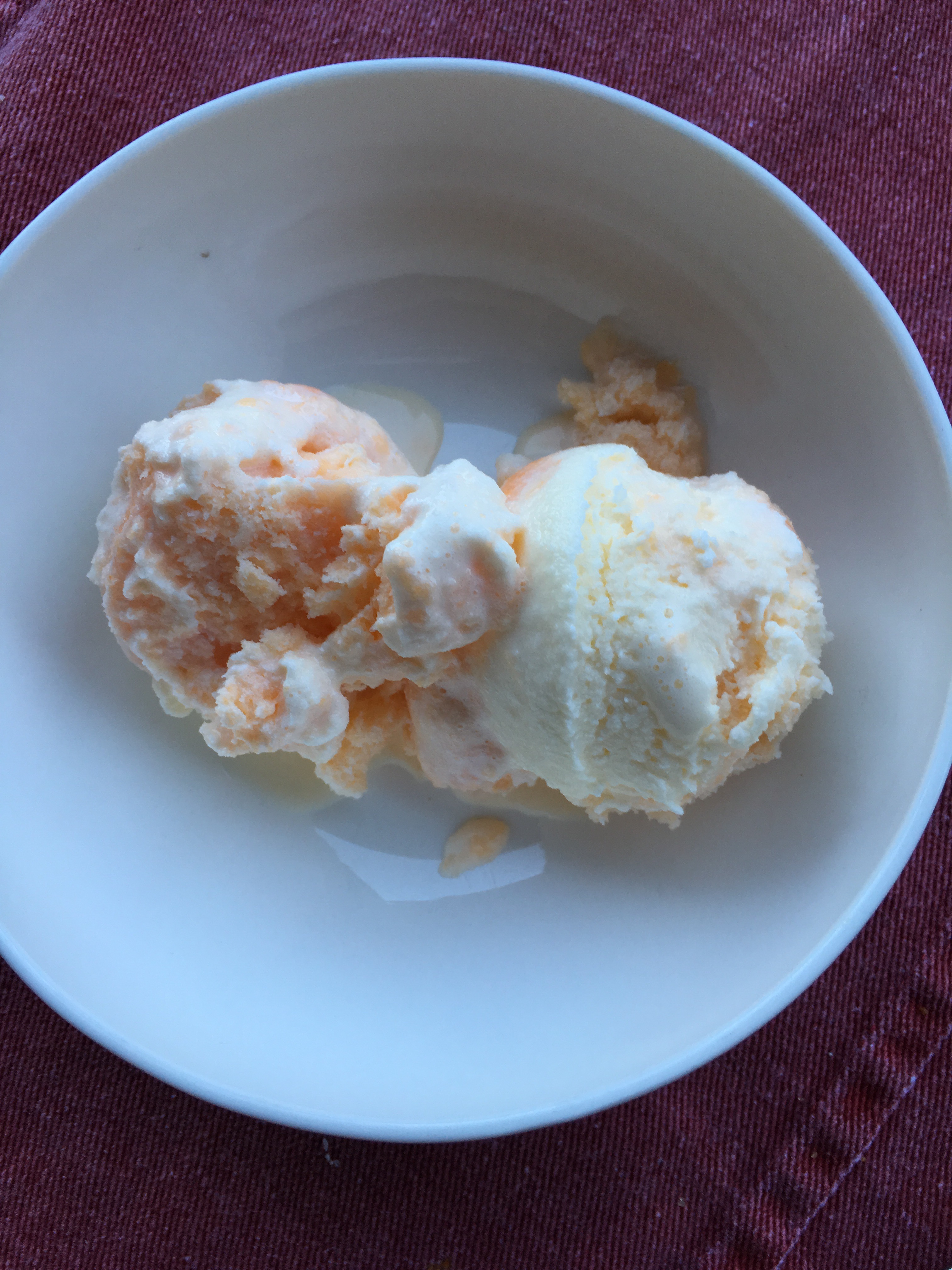
This week saw several newbies on our table, Quiche, courtesy of Miss Tess, who loves quiche and Tarte abondance , which is more or less a cheese quiche. Scones courtesy of Miss Tess and Young Mr Alfie , both tried scones and jam and cream on the BA flight over to Geneva last week, and decided they were a hit, and the final one was cantaloupe melon ice cream.Tess at the age of 6 loves to cook, and is good at it, Alfie (8) thinks he likes to cook, but does not like getting his hands dirty!


For our ice cream making the choice of flavour was a bit difficult. They both quiet fancied “Cherry Garcia” until Alfie read that it has chocolate in, he does not like chocolate, and Tess fancied Chocolate chip cookie dough, but again the chocolate issue.. So how about Oreo, umm not really, Oreos are hard to find here in France, Vanilla fudge chunk? Well it would mean having to make our own fudge, coconut? Kit Kat ? Toblerone? The list was endless, we finally settled on Canteloupe Melon. This might sound rather odd, but I have to say the result was excellent !

Ideally, to make this an ice cream machine is useful. I do have one that does the job for you as it has its own refrigeration unit, but the one I have in France requires the bowl of the machine being in the freezer for several hours before use, which is not at all convenient . Consequently I chose, just to put the mixture into the freezer and stir every half hour to mix thoroughly .The quantities given here make about a litre.


:1 small very ripe Canteloupe melon,

: juice of a lemon

:3 eggs

:3/4 cup (170 grms) caster sugar

:1 cup full cream milk (240 MLS )

:1 cup thick or double cream (240 MLS )
Whisk the eggs with the sugar until light and fluffy, add the milk and the cream, whisk to blend. pour into a container and freeze for about half an hour, stir, freeze again, and repeat, several times.

Meanwhile scoop out the melon,, mash using a hand held blender, put this also into the freezer.
When the ice-cream base is fairly stiff all over, stir in the mashed melon.

Return to freezer, stir a couple of times and then leave to set.
Remember to remove from the freezer, about 15 mins before use.
The same base can be use but substitute , a pound of strawberries for the melon.

And Another Soup

Today we were treated to another soup, normally I do not eat much soup #2 daughter, the willowy brunette, would eat it everyday, but I find it sends me to sleep.However, on this day. the soup in question was made, not by me, but by a dear friend Yuki. It was a lentil soup with curry oil and coriander, courtesy of the London Chef, Yotam Ottolenghi.

Ottolenghi grew  up in Jerusalem and moved to London in the 1990’s. The food in his restaurants is basically middle eastern  flavours, with many a twist. Other chefs have used a variation of his red lentil soup and as such has been passed down from generation to generation throughout the middle east. When we think of the middle east today, we think of Syria, Jordan, Israel, Lebanon,  Iraq and Saudi Arabia, but to that list we need to add Turkey and of course Egypt, but what about Sicily? it too has been ruled by the Arabs, so there will be middle east influence in their foods as well.

So Claudia Roden in her book on Middle Eastern Cooking, her version of lentil soup, adds cumin, whereas in Morocco, they add, spinach and cumin.Claudis Roden also says in her book on Jewish cooking that Lentils were very much part of the Sephardi diet, where they too add, cumin but also some or all of the following, Turmeric, chopped Chillies, Rice, chopped Tomatoes, Spinach, Coriander, Ginger, Saffron, Lemons and Mint.

So you can see that there are many variations on a theme, none of them are 100% correct but then again none of them are 100% wrong.

So for my version of this delightful and flavoursome soup, I start by making my own Chili oil;

  1. 200 ml oil, I use olive
  2. 2 red onions chopped
  3. 2 cloves garlic chopped
  4. a knob of ginger chopped
  5. 2 tsp curry powder. 2 tsp tomato paste
  6. juice and zest of 1/2 lemon or lime.
  7. half a red chili de-seeded and chopped.

Heat just a little of the oil, add the onion, the ginger, the garlic and curry powder and fry gently for a few minutes until the onion is soft, but not brown. Add the tomato paste and stir in well, Add the rest of the oil and the lemon zest and juice and simmer for 30 minutes, leave to cool and then drain.IMG_1913


For the soup

  1. 1 liter of stock ( vegetable or chicken)
  2. 4 oz Sugar snap  or Mangetout peas
  3. 2 tabs  Thai red curry paste
  4. 2 sticks lemon grass, bashed and chopped
  5. 4 Kaffir lime leaves ( from Asian super markets)
  6. 250 Grams, of either fine yellow or red lentils
  7. 2 tbs of lime juice, or the juice of one lime
  8. 1 can coconut milk
  9. 1/2 cup chopped cilantro ( coriander)
  10. 1 red onion sliced
  11. 3 tbs olive oil

Saute the onion until soft, add the curry paste, the lemon grass and the kaffir lime leaves, along with the lentils and the stock, cook for bout 20 mins, until the lentils are really soft.

Remove the lemon grass and the Kaffir lime leaves. Add the coconut and the lime juice , taste and add a pinch of salt.

Blanch the peas and slice into  chunks. Heat the soup, serve with some toasted sourdough bread, with the peas, cilantro sprinkled on top and a drizzle of chili oil.

Too Many Tomatoes

Today was a soup day. Not because it was a cold winters day. Quiet the opposite in fact. Here in London, it was overcast. hottish and muggy.

No, the reason for the soup was a glut of tomatoes. Not, I hasten to add from the tomatoes growing on my terrace but the glut from the market. I wandered down one of the many street markets at the weekend, to find that on one stall tomatoes were “In”. Several kilo- of tomatoes on the Vine for £3.00 How could I say No?

On unpacking, I was even more surprised to find that they were all , almost perfect and firm, so then the next challenge was to find room for them in the refrigerator.

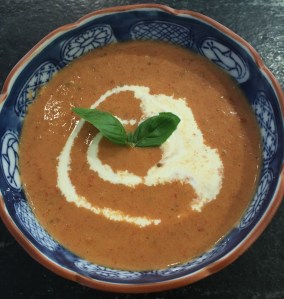
So now a week on, having had tomatoes in all shapes and forms, it is time to move on, and tomato soup was beckoning.soup 2

I often make tomato soup, using canned tomatoes, nothing can be easier, but today it was to be the real McCoy.

So for my soup, I used

  1. 1 1/2 kilo- of tomatoes,
  2. 2 onions sliced,
  3. 3  green chile peppers ( according to taste) de-seeded
  4. a lump of fresh ginger, peeled and sliced,
  5. a small handful of fresh basil,
  6. a small jar of sun-dried tomatoes, to give a depth of flavour,
  7. 1 1/2 L of vegetable stock
  8. small carton of sour cream + some to serve
  9. 2-3 cloves garlic
  10. Salt and pepper to taste.
  11. some basil leaves to serve.

Make a slit in the top of the tomatoes, place in a large bowl and pour over some boiling water and leave to stand for a few minutes. Then remove one at a time and with a sharp knife, from the slit, peel off the skin.( Tomato Soup, is so much nicer with no bits of  skin floating around.)

Put some olive oil in the bottom of a large saucepan and throw in the onions and the garlic. When the onions have turned translucent, add the tomatoes,  chiles, basil, ginger, stock and sun-dried tomatoes. Bring all to the boil and simmer until the tomatoes are very soft.

Cool slightly and then whizz in either a blender /food processor or with a hand blender to make the mixture smooth. Return to the heat, add the sour  cream ( plain yoghurt can be used, but it gives a bit of a dappled effect to the soup) taste and add salt and pepper. Serve hot with a swirl of sour cream and a few basil leaves, along with some toasted sour dough bread, Home made of course.soup 1

And the Real McCoy? where does that come from. Well from the USA,  as I understand it. The McCoy company made some pretty awful pottery items  in the early twentieth century, but was copied far and wide, but as with all these things, it was real if it had the correct signature on the base of the item. hence the real McCoy.


One day in June

This week, saw us dining out for breakfast, lunch and dinner, though not all on the same day. On the day of breakfast and lunch out, himself cooked me dinner that evening.
For breakfast we went to one of our local haunts, which is called Fischer’s, on Marylebone High street. It is a sister to The Wolseley , but smaller and quieter, maybe a little off the beaten track ( Marylebone High street , off the beaten track ??) The decor is muted along the lines of an Austrian hunting lodge. The last time here ( about 18 months ago) we were less than pleased, but last week no such doubts. For me, it was very simple, but very nice, yoghurt with berry compote, whilst for himself it was porridge and prunes, the porridge was a large portion and was very creamy and the bowl of stewed prunes enormous!

IMG_1728 (1)
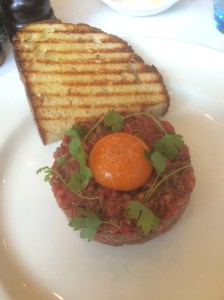
For Lunch we ventured even closer to home, a few hundred yards in fact to Galvin’s. The Galvin brothers opened this Bistro de Luxe 11 years ago, and initially the menu had a lot of offal, which is off putting to many, but now the menu is not so biased. The set lunch menu is very reasonably priced, although I chose to have two starters from the a la carte. First, came the asparagus , it is currently in season ( of course can now be bought year round, but this was English asparagus and the season is fairly short), second was the steak tartare , which I love.
We lived in Belgium for many years and steak tartare or filet americaine is common place. Youngest daughter, once was out with a young English friend , Katherine and had lunch in our favourite sandwich ( le sandwich) café. Daughter ordered her favourite and the young friend knowing no difference said she would have the same. Not until after they had finished, did Katherine , who thought the sandwich delicious,  ask, what she had just eaten. Moo came the reply, she was not so happy then !

Very often, when restaurants serve steak tartare , it is by using ground steak, but sometimes they do chop it finely instead and this is how it should be. Galvin’s chop their steak and I have to say it was excellent. Of course the best way to eat it is with a plate of double or triple cooked chips ( as the Belgians always do ), but that is being super indulgent!

I have given the recipe before, but in case you have forgotten.

To make your own Steak Tartare you will need:- ( for 4 people)

500g of beef fillet, diced or minced.          25g of shallot or red onion finely chopped

40g of cornichons, chopped.                       40g of baby capers, rinsed

20g of Dijon mustard.                                  

 90g of mayonnaise freshly made or  bought, but it must not be the fat free type

5 drops of Tabasco.                                        14ml of brandy

1 pinch of parsley, chopped.                          Salt and pepper to taste

To serve:-

4 egg yolks.       4 slices of sourdough bread and  Double cooked French ( Belgian ) fries.    100g of rocket .IMG_1727

And so onto dinner, where himself bought, shucked and cooked oysters. We had them in the form of Oysters Rockefeller , Yummy indeed, well they are if you like oysters.IMG_0026

“A loaf of bread,”

This week saw me at a bread making class. I used to make bread, firstly teaching 11 year old boys ( who were actually better at it than the girls) in an Inner London school. And although it shouldn’t be “bashed” around, they did, and it turned out edible ( well almost).

Move on a few years and whilst living in rural France, with a toddler, we picked dandelions for salads and made bread for lunch. What about the wonderful baquettes? Well, eating baquettes on a daily basis, soon became boring and they are not food for toast, beans on toast or sardines on toast,or for anything “on Toast”! and so number one daughter and I made bread a few times each week. In those days it was easy to buy fresh yeast, simply go to the bakers and ask, Levure s’il vous plâit. Since then, however my bead making endeavours have fallen off, though I should have continued whilst living in Texas, as to my mind their choice of bread left much to be desired and Sourdough had yet to reach Houston. And as Julia CHild once said, ” How can a Nation be great, when it’s Bread tastes like Kleenex”!!!!

So once after having spent the morning in the kitchen of the two Michelin star SAT BAINS, I was encouraged to go home and start making my own Sourdough bread. I have to say to mixed results, so on a whim, I sent myself off to the Bread  Shop in Borough Market, called Bread Ahead. Here they hold all sorts of Bread making courses, ranging from Sourdough to Gluten Free and from a half day course to a mind boggling three day course.

There I met the delightful Hilary , who is passionate about baking and especially about Sourdough. In fact she is so passionate about Sourdough she has written a book on the subject ( not yet available, but can be pre-ordered on Amazon….Sourdough Suppers: A Year in the Life of a Wild Yeast Culture  by Hilary Cacchio ).

She started the class off by explaining what a wild yeast culture is.Wild yeast are present in all flour, and so the easiest way to make a starter is simply by combining flour and water and letting it sit for several days. That is  the simple version.

Hilary had brought along to the class, some of her culture ( which will keep forever … well almost) she travels around the world with one or another of her wild yeast cultures, and the one we were to use was called Bruce. I now have my own culture  and it is called Alfie !

I will give you the basics for starting your own wild yeast culture, but for the rest, I would recommend going to one of Hilary’s classes or at least read her book.

50g Organic Strong White or Rye flour mixed with 50 g of cold water, mix these together and cover ( I covered mine with some cling film), and leave at room temperature. add to this each day for 4 more days, another 50 g flour and 50 g of cold water and mix well. By thern it should smell nice and be bubbly. I can now be covered but not sealed and refrigerated until ready to use. Before use it needs to be at room temperature for several hours ( maybe overnight) for the yeast to rejuvenate.book


So that is just the begining. Hilary can be found at http://hilarycacchio.com/

or Bread ahead  www.breadahead.com/courses

Happy Baking everyone!


WHAT A CHEEK!

As you must know by now, I have an obsession with markets, so last Sunday I was strolling along and found the Marylebone, Sunday  Farmers Market. Apparently , all food for sale has to be local, a bit difficult in Central London I imagine, but Hey Ho!  There are stalls selling English cheeses, a couple of Fishmongers ( a bit difficult to call these local ) a couple of butchers ( cows and sheep and goats grazing alongside the North Circular ?) But never mind, on a nice sunny Sunday, there is enough there to interest me. This week it was Ox Cheeks.
Ox Cheeks are those cuts of meat that no longer grace the supermarket shelves , being unfashionable and timely to prepare. A bit like in Texas , where it is almost impossible to buy any sort of Offal in the “American” supermarkets but amble on down to the”Mexican” ones and there I could buy Veal Sweetbreads, chip as chips! A pity that my kids thought they were indeed yummy, all the time they thought I was cooking chicken goujons, the moment I told them it was offal, they did a runner!
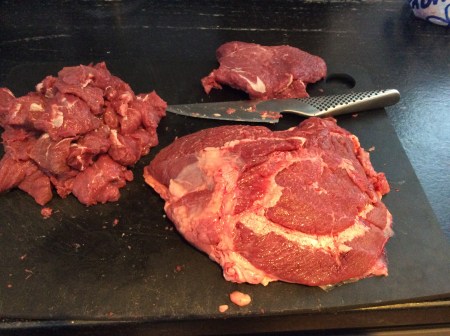
Still back to my Ox cheeks. They require a fair amount of cutting and removal of fatty bits and sinews , so a fair bit of waste, but then again not expensive. They also require a reasonable amount of cooking time, as they can be a bit tough ( just think about all the chewing that the cow has done). However, once that has been done, it is easy to throw it in a pan, put on a low heat and simmer for an hour or two. Of course the same idea/ recipe for

any cheaper cut of meat

.ox 1

So I used
1 1/2 kilos of Ox cheek ( de-fatted, de-sinewed, cut into smallish chunks)
2 large onions sliced
6 cloves of garlic, smushed,
4 carrots peeled and sliced
A dozen or so of green and black olives without stones
A dozen or so de-Stoned prunes
3/4 bottle of red plonk ( I actually used some  Port that was asking to be used)
1/3 jar red currant jelly
Some flour for dusting the meat.
Some Olive oil for frying.

Salt and Pepper to tasteox2

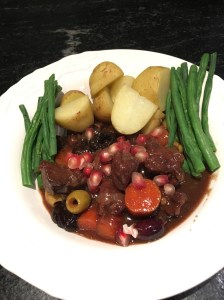
Heat the oil and sauté the onion and the garlic until soft but not brown. Remove and put to one side. Dredge the chopped up meat bits in the flour, ( the easiest way to do this is to put some flour into a polythene bag, add some of the meat, seal and give a shake, remove meat and repeat with the rest) sauté the meat in batches, to seal. When all the meat has been sautéed add  the onions, garlic and carrots along with the red wine, bring to the boil tune heat done, give a stir so that all the lovely bits from the frying get off the bottom of the pan, cover, reduce heat to just a simmer and leave for an hour or so. Give an occasional stir. Test by eating a bit of meat. When ready, add the olives, and the prunes and salt and pepper to taste. I topped it all off with a few pomegranate seeds, as they are in season at the moment

.ox3

Serve with new potatoes or pasta and some green beans, enough for four. Himself said Yummy !

Not Impressed

Whilst on our travels in Japan, we ate in many fine dining establishments, one star, two stars, but also a Japanese pub. So now back in London, we decided to try Italian. And the winner is??

As the group of 8 are now avoiding raw fish for a while, too much protein and not enough fruit and veg. we  headed  out to Angela Hartnett’s flagship restaurant ” Murano”. I have been a fan of hers for a while, with her down to earth approach, but that was long before she had her own restaurant.  She was once the head Chef at The Connaught, one of Ramseys restaurant in London. We dined there for son’s university graduation, with the Ladies Who Lunch and in  the kitchen at the Chefs table for a daughter’s birthday. Then once she moved to Murano, a couple of times, again with the Ladies Who Lunch. So I felt that I had a history with Angela ( even though I had never met her).

Murano is one of the few  good restaurants that will take reservations for 8, for many 6 is the maximum. This was my choice of restaurant and I was confident that we would eat good food and have a fun evening.

It is a relatively small restaurant with only 55 covers and we were seated at the back, which is not the best place to be, given that it was by the kitchen door!  Four of us were seated on the banquette, however we had to ask for an extra chair, as four on the banquette was too much of a squeeze. We then had to rearrange the table settings ourselves, which surprised me somewhat.

The menu is interesting, it is priced for how many courses are eaten, there is not one which says starters, nor one for main, you can choose which order to eat them in. The pre appetizers were good, tiny arranchini with parmesan, Italian cold meats bread and olive oil. The small plates were not cleared away ( they remain so we can put food on them? strange, as we had eaten all of the nibbles). So plates were pushed to the middle of the table, as there was certainly not enough room elsewhere. Food arrived and on the whole it was good, I chose for my starter the parmesan gnocchi with wild boar and to follow green asparagus ( new season) and for my main Monkfish. This was a disappointment as it was cold. It was sent back and returned to me very quickly, not sure how it had be re done that fast!

The evening was fun as we were with friends for a special evening but to my mind there was too much wrong . The dirty plates left on the table, the position of the table, the maitre d” not knowing his Mooli from his Daikon and of course my monkfish being cold. They did apologise profusely, but not enough to warrant a return even though they did offer a free lunch. So back to my question, one star, two stars Japanese, or one star London? I am afraid Japan wins this contest.

Michelin Two Stars, Japanese style!

SO today we head back to Tokyo, after a very busy and exhausting ten days or so on the road.After exploring the Buddhist village of Koya-san, we wait for the bus to take us to the funicular, to head on down the mountain back to Gokuuraku-bashi, to Shin-Imamiya to Osaka, the Osaka circle line to Shin Osaka ( new Osaka station) to catch Bullet train # 526 to Shinagawa where we will learn about travelling on the Tokyo subway system during rush hour.

At some point on this multi train journey we all ( minus our leader) charge for an empty carriage, which then leaves us wondering where and when we would change trains. Fortunately our men are a good deal taller than most of the other travellers and one manages to change carriages, so he could keep an eye on us all. Must not misbehave again, is the motto here, I think.

So, on arriving at Shinagawa, ( a new station just outside of central Tokyo) we change to the subway. Remembering we have been travelling but as our main luggage has been sent on ahead we do only have small wheelie bags. However the carriages are jammed packed and other travellers have enormous cases with them. We only need to travel about three stops, but more and mor people pile in and by the time we arrive at the Shimbasi station we wonder if we will be able to alight, especially as there are professional pushers,on the platform, pushing even more people on board. So with myself being almost lifted out of the carriage somehow or other we do all manage to leave the train in one piece.

So now it is a quick shower and change and onto our last dining experience. Japan has 25 three star restaurants ( only one behind France) and 99 two starred, which is considerably more than France. However, I am not sure how these stars are awarded, Service, cuisine, or non cuisine as the case maybe, presentation, I really do not know. But anyway we were going to KIKUNOI, which is owned by Yoshiro Murata. he himself holds 7 stars. His main restaurant is in Kyoto and he is the third generation owner. He now has a restaurant in London, which I think is called Murata.

His Tokyo restaurant is small, with only two alcove tables, 3 normal tables and 8 counter seats. We had the counter seats, which inhibits conversation but does give a bird’s eye view of the chefs.

Japanese haute cuisine or Kaiseki, relies not so much on the cooking but on the visual and the combination of textures , colours and flavours. Most of all it has to look stunning.

We took the 11 course tasting menu and started the evening with some cherry blossom sake followed by some sparkling Sake which is milky in appearance.The subsequent courses were :-

  1. Tosazu dressed pickling (Japanese Spanish Mackerel) Sagoshi, with onion and fennel
  2. Red sea bream sushi with prickly ash bud, grilled squid with nori and egg yolk,mountain yam,octopus, lily bulb petals with salmon roe, udo stalks, sea bream liver pate with white poppy seeds, shrimp and avocado and ostrich fern.
  3. Sashimi of red snapper and red sea bream, seaweed curled udo stalk and carrot wasabi
  4. Sashimi of squid with squid liver sauce


  5. Steamed tilefish, cherry blossom petals, cherry leaf,fern heads,rice crackers dumpling and ginger juice
  6. Grilled smoked ocean trout and duck breast
  7. Strawberry and wasabi sorbet

8.Kinome tofu, udo stalk, butterbur, bud licorice, kinome herb.


9.   Japanese hot-pot with red sea bream, seaweed, wasabi and sesame sauce

10.Steamed rice with  Bamboo Shoots, green pea soup and Kinome herb

11. Sweet bean paste soup with rice cake and milk ice cream

12.Almond jelly hassaku orange with Thai basil seeds..

This was probably the most beautiful meal we had whilst on our travels,  but was it the best? I am not sure, some of our group, did not like it at all, too much raw fish, but then this is Japan, it certainly was the most expensive and looking at my notes, I put against the grilled salmon trout and duck breast YUMMY! and against the strawberry and wasabi sorbet, I wrote Wow!

So now back to London and it is Thursday, it must be Egg and Chips? Maybe not!!

Koyasan, Monastries, Shrines and Monks

So today we were heading off to Koyasan, the  Holy mountain, another World heritage site. This involved several trains, subways and even a funicular  as well as a bus! Having sent our main luggage onto Tokyo, we were travelling fairly lightly.We journeyed on a Bullet train and a private railway ( the Nankai railways express). On arrival at Gokuraku-bashi we changed to the Nankai Funicular to Mount Koya.

Mount Koya, or Koyasan, is a mountain retreat, with 117 Temples and 200,000 shrines/tombs. These tombs/shrines are for people of all classes and have been built among the cedars of Mount Koya, many of which are obviously visited as they are either drapped in clothes or flowers.

The whole of Koya-san is dedicated to temples and shrines and the monasteries act as the local B and B. We stayed in the SEKISHO-IN,  ( 60 rooms) which actually can be booked on Booking.com and is mentioned on Trip advisor, so not as remote as one is given to believe. Guests can experience staying in a historic Buddhist temple all of the  rooms are Japanese-style with Tatami straw floors and futon bedding, yukata robes are also provided and no shoes are allowed. We were lucky to have rooms with private bathrooms and wi-fi whereas the rooms in the main wing had shared facilities. Meals, which were vegetarian, were to be taken in the main dining room and guests were encouraged to take part in the prayer session held at 6.30 every morning.

We checked in and then promptly went for a walk through the cedars ( Okunoin), amazed by the sheer number of tombs, until we came to the mausoleum of Kobo Daishi ( the founder of a monastic center here 1,200 years ago). Visitors are allowed, but photography is not. We returned to the temple in time for dinner ( 5.30) and we were shown a small private dining room. Dinner, was as I said vegetarian and was beautifully served in traditional lacquerware.

We had the foresight to buy and transport with us a 1.8 Litre of sake, suspecting that it would be a “dry” evening otherwise.Thankfully, our rooms had a heater and a kind of electric blanket, drapped over a table and also a couple of chairs, so we all congregated, feet under the electric blanket, heater blasting and drinking Sake. It was only the next day we saw the notice saying ” no food or drink in room!” We woke up the following morning only to find that the temperature had dropped overnight to minus!! Thank goodness for heated japanese toilet seats!  We could have stayed there all day! Breakfast ( after going to the morning prayers, where there was a lot of chanting,) was an affair, better not remembered, more miso soup, and more Tofu and rice I suspect, though as I say, better not remembered. Two of our midst had the foresight to bring some pastries with them from the previous hotel.

After breakfast we inspected the rest of the village, which was extremely beautiful, well-kept and some lovely very old buildings, more zen gardens and cherry blossoms. Even the local shop was selling sweetmeats, made with rice and red bean paste to resemble cherry blossoms.

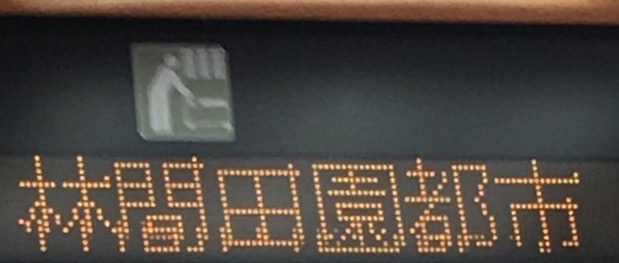
And so we were to make our way back to Tokyo, and this too was an adventure. On a last note, I photographed this sign, which is in Chinese Characters. I found it interesting. Do you know what it says ( well at least the first part).ks15


Golden Temples, Royal Palaces, 1,000 Buddhas and some shopping!

Today, we saw a golden Temple, more cherry blossom, a Royal Palace,  a 1000 Buddhas and an antique shop, along with the Kyoto handicraft centre.

We took a tour, not my favourite occupation but it is the most efficient when you have so little time in such a lovely city. Our tour guide spoke passable English but , and this I assume is what they learn in Tour guiding school, they repeat and repeat and repeat, which gets to be a bit tedious after a while. Still moving swiftly along,  we went to the “Temple of the Golden Pavilion” or the Kinkaku-Ji Temple. It is probably one of the most recognisable images of Kyoto. The temple is set on th edge of a small lake, which reflects the beautiful temple. It was originally built for Shogun Ashikaga Yoshimitsu (1358-1408) but was converted to a Zen temple shortly after his death. It is covered in gold leaf, which comes from Kanazawa. The park in which the temple sits is particularly pretty and has some interesting bamboo structures to support many of the trees.

Then we were very lucky to be able to go into the grounds of the Royal Palace, not normally open on a Sunday, and in fact not open very often at all. This year open to the public  from the 6th to the 10th April and the ancient game of football (Kemari) of the Imperial  court on to be played on the 10th. So we were very lucky indeed.

Kemari was first played in Japan around 600AD, it is a non competitive ball game and the idea is to keep the ball in the air, using any part of the body. the clothes or uniform come from the Asuka era ( 600 Ad) including the hat. Apparently George H.W. Bush played it on his visits to Japan! Nowadays it is only played as a demonstration game and at festivals.

Then it was a quick visit to the Handicraft centre, read souvenir shopping, some of it was good examples of local handicraft, fine embroideries, ancient silk kimonos reworked into ties and scarves and some of it typical souvenir type of goods.  Himself continued onwards to see the 1,000 buddhas, which he said was impressive but No photography. Shame really.

Me, I absconded and visited an antiques shop where I bought a lacquerware and gold leaf box, which I was told was used at christmas, and the cook would place all sorts of special foods in each compartment.

From there I went to a Department store, which was just beautiful it puts Harrods to shame, everything was beautifully presented  and well laid out. The food hall was just amazing and HUGE. I could have spent all day there. I managed to buy a few items whilst there, one being a japanese omelette pan, which I have yet to use, but firstly I need to learn how to do it, Not as easy as one might think.

Tomorrow we will head out for a real adventure, but not before I visit a local market.